Vampire daylight vulnerability
I Am LegendVampire daylight vulnerability is the rule that sunlight harms the vampires and, in the case of the truly dead, can kill them with astonishing speed. It first appears as an observed pattern: the vampires remain inside during the day, gather outside at night, and withdraw at dawn. Robert Neville eventually identifies sunlight itself as the active cause, linking its infrared and ultraviolet rays to the destruction of one vampire. The discovery gives a physical explanation to what might otherwise look like folklore, while also defining the daily rhythm of the ruined world and the limits of Neville’s own safety.
Observable Pattern and Daily Boundary
The rule is established through repetition before Robert Neville understands it scientifically. Each night the dark figures surround Robert Neville's house, but at five-thirty in the morning they begin to leave, muttering with dissatisfaction as another night ends. Their retreat is not voluntary in any ordinary sense: by dawn they are weaker than when they arrived, unless they have attacked one of their own. The contrast makes daylight a temporal boundary separating the vampires’ period of activity from their enforced concealment.
That boundary shapes Neville’s entire existence. During the day, he can move through the silent streets, dispose of bodies, and investigate the plague while the vampires remain hidden. At night, the same world becomes inaccessible, and his house turns into a besieged enclosure. The rule therefore has both physiological and spatial consequences: sunlight determines where the vampires can be, when they can act, and how long they can sustain an assault.
The Discovery of Sunlight as a Lethal Agent
Robert Neville initially treats the vampires’ daytime confinement as a fact without understanding its mechanism. While handling a dead vampire, he notices that the man has changed with extraordinary speed. The body is unmistakably dead, yet it already looks and smells as though death occurred days earlier. Nothing conventional explains the collapse: the heart has not been touched, and no garlic is present. The sudden decomposition forces Neville to search for an environmental cause.
He then recognizes daylight as the answer. The realization is accompanied by self-reproach because the vampires have remained indoors by day for five months, yet he has failed to connect that behavior with sunlight. He identifies the sun’s infrared and ultraviolet rays as the likely agents, but the discovery immediately opens a further scientific problem: whether sunlight affects only the fully dead or also those who remain biologically alive while infected. The rule thus emerges not as a complete supernatural axiom but as the first result of an investigation into different stages of vampiric transformation.
Biological and Epidemiological Meaning
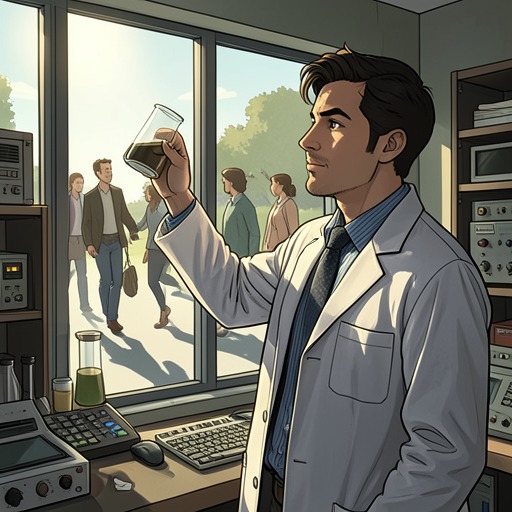
The daylight rule becomes more intelligible when Robert Neville begins to interpret vampirism as an infection rather than a purely legendary condition. His reading about bacteria, sunlight, and insect transmission suggests that the same disease process may account for several apparently separate facts. Strong sunlight kills many germs, and flies and mosquitoes can disseminate bacterial diseases; these observations help him imagine a plague carried through an infection network rather than through isolated acts of supernatural assault.
Within this model, the vampires’ daytime coma is a protective response enforced by the germ. The organism withdraws its host from solar radiation, while the infected body’s nighttime activity is sustained by the disease. Neville even considers whether the bacterium that kills the living might provide energy to the dead. Daylight vulnerability therefore connects the epidemiology of the plague to the physiology of the vampire: the sun is not merely an emblem of purity, but an environmental stressor against which the infectious organism must protect itself.
The rule also intersects with animal transmission. Mosquitoes, flies, and sand fleas are present in the same environment as the epidemic, and Robert Neville’s observations of a stray dog raise the question of whether infection behaves identically across species. The dog can roam outdoors during daylight, although Neville suspects it may be carrying a small dose of bacilli. Its uncertain condition complicates any simple division between daylight-safe living creatures and daylight-sensitive vampires, showing that vulnerability depends on the degree and form of infection rather than on appearance alone.
Relation to Neville’s Methods and Conflicts
Sunlight is the condition that permits Robert Neville to investigate. In daylight he can approach the plague’s consequences, travel through deserted streets, and work at the corpse-burning pit, where an excavated field has become one enormous fire-filled cavity. He wears gloves and a gas mask while dragging bodies to the edge and pushing them onto the smoldering ashes. The sun does not eliminate the danger of the epidemic, but it gives him a narrow interval in which the infected population cannot openly pursue him.
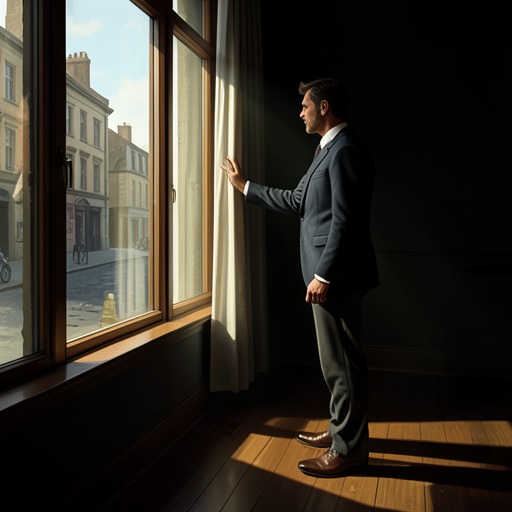
The same principle governs his surveillance of the house. Neville watches through a peephole as night figures gather outside, while the vampires’ withdrawal announces that the dangerous period has ended. Earlier, he had watched them through a front-window peephole, but stopped after the women saw him and adopted obscene postures to entice him outside. Even when he refuses to look, their voices and movements remain part of the nightly assault. Daylight protects his body, but it cannot entirely protect his mind from the pressure of the recurring siege.
His reliance on the rule also exposes the limits of isolation. When Ben Cortman comes onto the lawn and calls for Neville, the exchange remains contained by the daily cycle: Cortman appears at night, while Neville can expect the group to weaken and depart by morning. Later, when a new vampire society attacks Robert Neville's house in dark cars equipped with spotlights, guns, axes, and pikes, the old pattern of passive nocturnal harassment becomes an organized operation. The attackers use artificial illumination against their own kind and against Neville’s defenses, demonstrating that technological control of light can alter the balance that natural daylight once provided.
Consequences and Narrative Significance
Vampire daylight vulnerability transforms sunlight into a rule of survival, but its deeper importance lies in the way it changes the meaning of knowledge. Robert Neville begins with observations inherited from vampire lore and gradually replaces superstition with causal explanation. The vampires stay indoors because the germ protects itself from solar radiation; the dead body collapses because sunlight has destroyed the organism sustaining it. The rule is therefore the point at which legend becomes an object of laboratory-style inquiry.
Yet the discovery does not restore Neville to a stable human world. He remains alone, and his daily routines of cleaning, drinking, reading, and gathering garlic coexist with the knowledge that the night will return. His body is still subject to cravings and pressures he cannot master, while the vampires’ vulnerability offers only temporary relief. Daylight creates a defensive interval, not a cure.
The final reversal makes the rule part of the novel’s broader challenge to fixed definitions of normality. Robert Neville has used daylight to observe and destroy the vampires, believing that he occupies the position of the normal survivor confronting an abnormal species. But when the new vampire society captures him, he wakes injured behind barred windows and remembers the dark men attacking his house. The daylight boundary that once separated him from them no longer guarantees his freedom. What had been his scientific advantage becomes one element in a world where the organized majority can define him as the dangerous remnant. Vampire daylight vulnerability remains physically real, but it can no longer determine who possesses social power or the authority to name the monster.